

[ad_1]
“People in the operation see a lot of opportunity,” says Irani-Famili, who has worked in the energy industry for most of a decade. OT dreams of possible fixes for the problems they face every day. For example, if there is a power outage, the relevant supervisors can automatically receive notifications wherever they are. Or staff availability data can flow through company systems so supervisors and managers can more easily assign projects or shifts.
“Then they go and talk to BT and BT’s response is ‘Not possible. “This could be violating every security protocol,” says Irani-Famili. Operations see solutions to problems. IT sees the risk of cybersecurity, integration and support. “But from an operations perspective, the IT bureaucracy they see is IT not collaborating or IT playing games.”
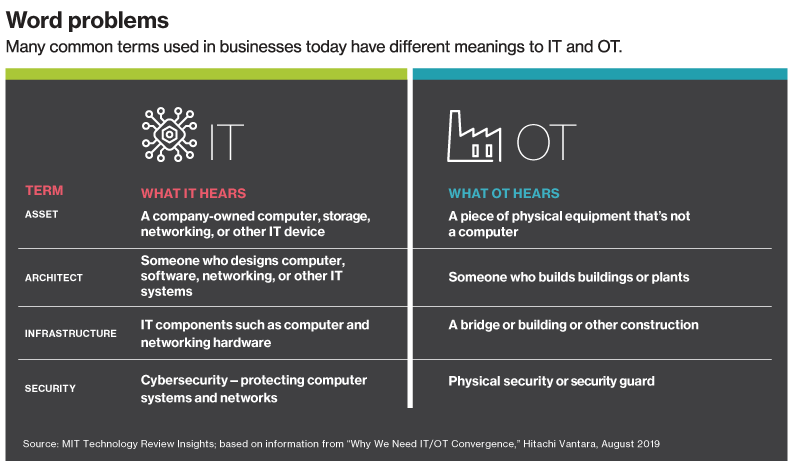
It is easy to define IT and OT as different departments with different goals and completely different cultures. They are often managed independently in organizations and are treated as isolated groups that address specific problems and use their own protocols. However, this results in inefficient, costly installations that do not encourage innovation and standardization.
Pressure is mounting to boost productivity, innovation and agility as global economies gain momentum after nearly collapsing amid the 2020 coronavirus pandemic. Companies need to accelerate business by digitizing processes and extracting actionable insights from large datasets using the Internet of Things and artificial intelligence (AI).
To go through such a digital transformation in industries that rely heavily on physical assets (manufacturing, oil and gas, transportation, energy, and utilities), organizations must integrate IT and OT into a seamless organization that connects systems on both sides.
“IT/OT convergence is inevitable,” says Fay Cranmer, senior general manager of Accenture’s natural resources practice and former chief computing officer at mining company Rio Tinto. “This is the only way to have a complete digital transformation, especially in heavy industry.”
But there are significant challenges to overcome. Many industrial environments are characterized by legacy equipment, well-established, manual processes and resistance to change from both parts of the business, OT and IT. Usually the approach is this: OT alone knows how to produce products and services that generate revenue for the company.
Conversely, IT professionals often think they know how to help modernize OT departments by enabling systems that allow the benefits of artificial intelligence, IoT, and other digital technologies. True collaboration is a must, but the complexity of new technology and infrastructure combined with legacy machines raises questions about investment, leadership and governance.
Bala Arunachalam, an oil and gas executive for over 30 years, says certain industry specifics are a big factor. “This industry is an old industry. It is a struggle for them to move into the field of technology, to seize the opportunity in front of them.”
While physical assets, whether in the factory or in the field, are digitized with the internet of things technology; as applications, data storage and data processing move to the cloud; and as employees have been tied to their home offices for more than a year in the pandemic, all perceived boundaries between OT and the rest of the business are collapsing. “The challenge is that we need to aggregate data across all these boundaries,” Cranmer says. He says the biggest obstacles are organizational and cultural. “The technological side is much easier to overcome from the human side.”
The good news is that there are guidelines organizations can follow to achieve the IT/OT integration that is so critical to successful digital transformation initiatives.
Download full report.
[ad_2]
Source link