

[ad_1]
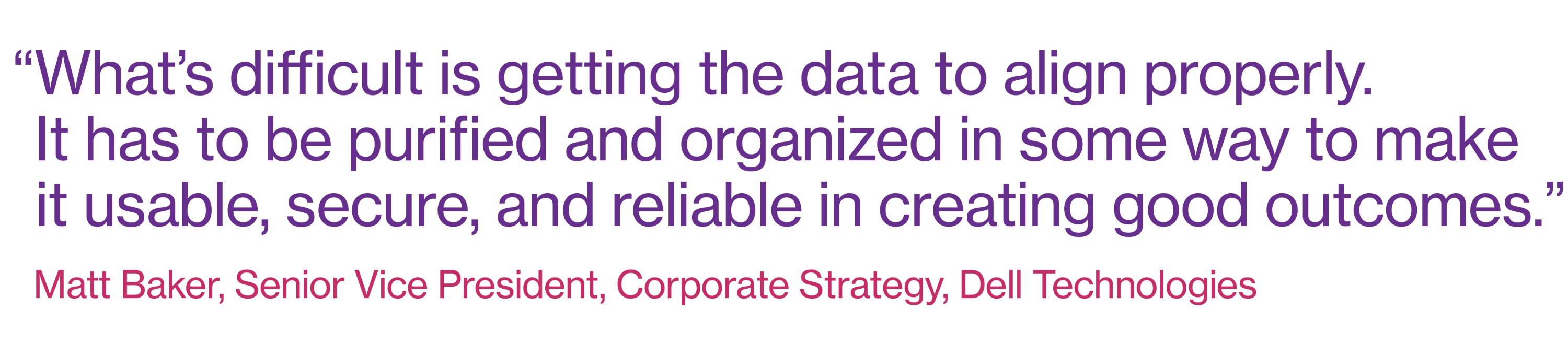
But, says Matt Baker, senior vice president of enterprise strategy at Dell Technologies, the right amount of clean and properly channeled data can quench a business’s thirst for insight, fuel growth and drive success. Like water, data is neither good nor bad. The question is whether it is useful for the purpose at hand. “The challenge is to get the data to align properly in an inclusive, collaborative fashion,” Baker says. “It must be purified and organized in some way to make it usable, safe and reliable in producing good results.”
Many organizations are overwhelmed by data, according to a recent study of more than 4,000 decision makers conducted by Forrester Consulting on behalf of Dell Technologies.1 In the last three years, 66% have seen an increase in the amount of data they generate—sometimes doubling or even tripling—and 75% say the demand for data in their organization is also increasing.
research company IDC estimates that the world produces 64.2 zettabytes The number of data in 2020 and this number is growing 23% per year. A zettabyte is a trillion gigabytes—putting that into perspective, this is adequate storage For 60 billion video games or 7.5 trillion MP3 songs.
Forrester research showed that 70% of business leaders accumulate data faster than they can analyze and use it effectively. Managers have enormous amounts of data, but lack the means to derive insight or value from it – Baker’s, Samuel Taylor Coleridge’s epic poem “Water, water is everywhere and not a drop to drink.”
Data streams turn into data floods
It’s easy to understand why the amount and complexity of data is growing so fast. Every app, gadget, and digital transaction creates a stream of data, and these streams flow together to create even more streams of data. Baker offers a potential future scenario in physical retail. A loyalty app on a customer’s phone tracks their visit to an electronics store. The app uses the camera or a Bluetooth proximity sensor to figure out where it is and taps the retailer’s knowledge of the customer’s demographics and past buying behavior to predict what they can buy. When walking through a certain corridor, the app generates a special offer for ink cartridges for the customer’s printer or an upgraded controller for the game box. It notes which offers resulted in sales, remembers it for next time, and adds the entire interaction to the retailer’s ever-growing pile of sales and promotion data, which can then lure other shoppers with smart targeting.
Adding to the complexity is often a bulky chunk of old data. Most organizations don’t have the luxury of building data systems from scratch. “They may have years of accumulated data that needs to be cleaned to be potable,” Baker says. Even something as simple as a customer’s date of birth can be stored in half a dozen different and incompatible ways. Multiply this “contamination” by hundreds of data fields, and clean, useful data suddenly seems impossible.
But Baker says abandoning old data means abandoning potentially invaluable insights. For example, historical data on warehouse stock levels and customer order patterns can be crucial for a company trying to build a more efficient supply chain. Advanced extracting, transforming, loading capabilities designed to organize and harmonize different data sources are essential tools.
Download full report.
This content is produced by Insights, the exclusive content arm of MIT Technology Review. It was not written by the editorial staff of MIT Technology Review.
[ad_2]
Source link