

[ad_1]
A few years ago, a young man from California’s tech scene started popping up in the world’s leading developmental biology labs. These laboratories were deciphering the secrets of embryos and were particularly interested in how eggs were formed. Some thought that if they discovered this recipe, they could copy it and turn any cell into an egg.
Their visitor, Matt Krisiloff, said he wanted to help. Krisiloff did not know any biology and was only 26 years old. But after leading a research program at renowned start-up incubator Y Combinator, one of the first funders of companies like Airbnb and Dropbox in San Francisco, it’s “well-connected with access to wealthy tech investors.”
Krisiloff also had a particular interest in artificial egg technology. He was gay and knew that theoretically a man’s cell could be turned into an egg. If this were possible, the two men could have had a child genetically related to both. Krisiloff, “’When can same-sex couples have children together?’ I was interested in the idea,” he says. “I thought it was a promising technology to do that.”
Today the Krisiloff company started, getting pregnantis the largest commercial enterprise pursuing what is called in vitro gametogenesis, which refers to the conversion of adult cells into gametes such as sperm or egg cells. It employs around 16 scientists, and Sam Altman, CEO of OpenAI and former president of Y Combinator; Jaan Tallinn, co-founder of Skype; and Blake Borgeson, co-founder of Recursion Pharmaceuticals.
The company is initially trying to produce spare eggs for females. This is scientifically easier than making eggs from male cells and has an open market. People do have children later, but a woman’s healthy egg supply is in her 30s. This is an important reason why patients visit IVF clinics.
The concept begins with blood cells from female donors and attempts to turn them into the first “proof-of-concept human egg” made in the lab. The company hasn’t done that yet – nor has anyone else. There are still scientific puzzles to be overcome, but Krisiloff sent an email to supporters earlier this year, saying that his initiative could be “the first in the world to achieve this goal in the not-too-distant future.” He says artificial eggs “may be one of the most important technologies ever created.”

NICOLáS ORTEGA
This is no exaggeration. If scientists could procure eggs, it would be breaking the rules of reproduction as we know it. Women who do not have ovaries – for example, due to cancer or surgery – may have biologically related children. What’s more, lab-produced eggs remove age limits on women’s fertility, allowing women to have consanguineous babies at age 50, 60 and even beyond.
The possibility of egg cells from a blood draw is very profound and ethically fraught. Conception’s process of making eggs from stem cells required human fetal tissue. And if reproduction deviates from the accepted facts of life, unusual scenarios can arise. It opens the door not only for same-sex reproduction, but perhaps for one individual—or all four—to produce an offspring.
More realistically, the designer can strengthen the path to children, as technology can turn eggs into a manufactured resource. If doctors can make a thousand eggs for a patient, they can fertilize them all and test to find the best embryos. scoring your genes for future health or intelligence. Such a laboratory process would also allow for unlimited genetic editing with DNA engineering tools such as CRISPR. As Conception noted in a presentation it sent earlier this year, the company speculates that artificial eggs could allow “large-scale genomic selection and editing in embryos.”
Krisiloff says, “If you could make a meaningful choice against Parkinson’s risk, Alzheimer’s risk, then I think that would be very desirable.” The potential commercial and health benefits could be enormous.
For scientific reasons, it’s expected to be more difficult to turn a human cell into a healthy egg, and Conception hasn’t even tried it yet. But it’s also part of the company’s business plan. Perhaps when Krisiloff is ready to start a family, the two boys will be able to contribute equally to the genetic makeup of IVF embryos. A surrogate mother can then carry the child until term. “I think it would be possible,” Krisiloff told MIT Technology Review. “The question is when, not if.”
a mouse tail
Here’s how egg-making technology can work. The first step is to take a cell – a white blood cell, for example – from an adult and turn it into a powerful stem cell. This process is based on a Nobel Prize-winning discovery called reprogramming that allows scientists to make any cell “pluripotent” — capable of forming any other type of tissue. The next step is to turn the induced stem cells into eggs whose genetic makeup will match that of the patient.
The last part, which is the scientific challenge. Some cell types are very easy to make in the lab: leave the pluripotent stem cells in a container for a few days and some will start beating on their own like heart muscle. Others will be fat cells. But an egg may be the hardest cell to produce. Very large – one of the largest cells in the body. And its biology is also unique. A woman is born with all her eggs and never does it again.
In 2016, a pair of scientists in Japan, Katsuhiko Hayashi and her mentor Mitinori Saitou, were the first to transform skin cells from mice into fertile eggs completely outside the body. Them reported how, starting with cells from a tail clipping, they induce them into stem cells and then guide them part of the way towards becoming eggs. They then incubated these proto-eggs alongside tissue collected from the ovaries of mouse fetuses to complete the task. In fact, they had to build mini ovaries.
“It’s like, ‘Oh, can I make an egg in a petri dish?’ It’s not a matter of. It’s a cell attached to its place in the body,” says David Albertini, an embryologist at the Bedford Research Foundation. “So it’s about creating an artificial construct that can summarize the process.”
unexpected visitor
A year after the mouse discovery in Japan, Krisiloff began visiting biology labs to find out if the process could be replicated in humans. He came to Edinburgh in the UK, spoke on Skype with professors in Israel, and also made a pilgrimage to Hayashi’s headquarters at Kyushu University in Fukuoka.
It was there that he met biologist Pablo Hurtado González, who was visiting that lab on a scholarship and would join Krisiloff as the founder of Conception. A third co-founder, Bianka Seres, an embryologist working at an IVF clinic, later joined the team.
Krisiloff, a graduate of the University of Chicago, was by then director of Y Combinator Research, where he launched a project to explore providing a basic monthly income to people in the San Francisco area. Y Combinator is the most famous startup academy in the world. his opinion research project was to give money unconditionally as a strategy to prepare for a future where jobs are taken over by automation.
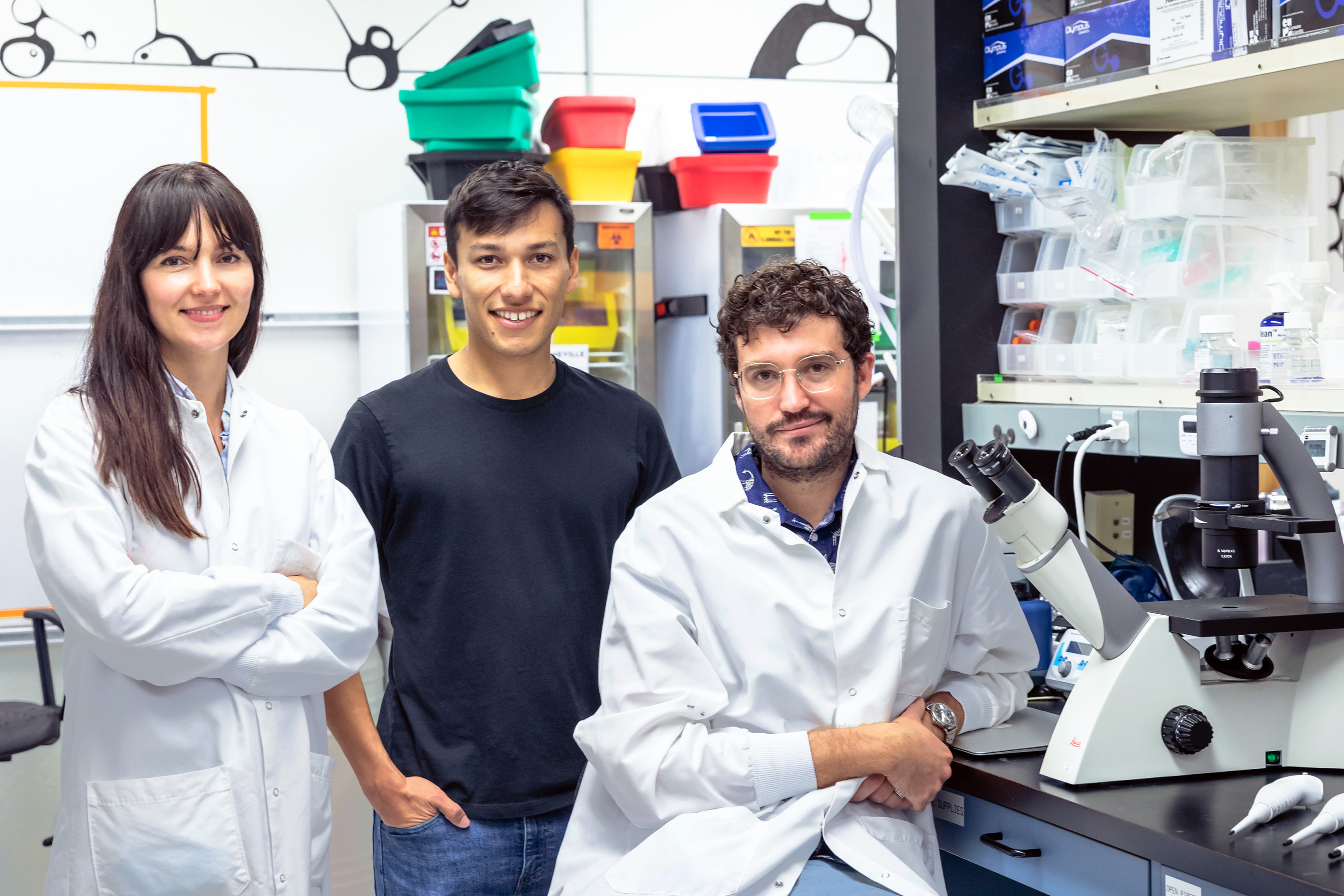
CHRISTOPER WILLIAMS
Krisiloff said she resigned from that post after she started dating Altman, who was then president of Y Combinator. Although the relationship didn’t last long, the job change freed her to work full-time with Altman’s initial investment in the nascent egg venture. The company was originally called Ovid Research and this month changed its name to Conception.
Some researchers felt that young entrepreneurs were over their heads. The science of in vitro gametogenesis is dominated by a small staff of university research groups who have been working on the problem for years. “When I talked to them, they had no idea, absolutely no idea how to start a project,” Albertini says. “They asked me what kind of equipment they would buy. ‘How do you know when you’re laying eggs? How would it look?”
Another scientist Krisiloff knew was Jeanne Loring, a stem cell biologist at the Scripps Research Institute. Working with the San Diego Zoo, Loring had previously frozen cells from one of the zoos. the last northern white rhinosan endangered species. He was interested in egg-making technology if it was to resurrect the animal. “They are young and optimistic and have money in their pockets, so they are not dependent on persuading people,” Loring says. “Sometimes it’s a really good idea to be naive.”
What Krisiloff knew for sure was that reproductive technology could be as appealing to tech investors as artificial intelligence or space rockets. As Stanford University reproductive endocrinologist Barry Behr says, “If you write ‘fertility’ on a carton these days and take it to Sand Hill Road, you can make money.”
The problem with artificial gametes is that it won’t be a medicinal product for many years, and there are complex obligations as to who is to blame if the final baby isn’t normal. Krisiloff did not see these as obstacles to starting a company. Indeed, he believes more startups should try to solve “hard” science problems and discoveries can happen faster in a commercial setting. “My argument is that there could be a lot more funding if people turned research organizations into nonprofits,” he says. “I have great faith in ongoing more fundamental research in the corporate context.”
fetal tissue
Krisiloff’s company has never issued a press release or received public attention. This is because his team has yet to make a human egg and doesn’t want to be seen as someone promoting biological “steamware”. Krisiloff says Conception is still trying to achieve its first technical benchmark—that is, producing a human egg and a patented process for making them.
This is also the target of academic researchers, such as those who make mouse eggs in Japan. But replicating this discovery with human cells is daunting. Experiments can take almost as long as a pregnancy, as the recipe involves mimicking the natural steps in which eggs develop. This isn’t a big deal for rats born at 20 days, but in humans each experiment can take months.
When I met Saitou and Hayashi in 2017, they said that replicating mouse technology in humans is another troubling challenge. Replicating the recipe would require abortion tissue: scientists would have to obtain follicle cells from week-old human embryos or fetuses. The only alternative would be to learn how to produce these necessary support cells from stem cells as well. They estimated that this in itself would require a significant research effort.
At Conception, the scientists started by experimenting with the fetal tissue approach, which they believe is the fastest way to obtain a proof-of-concept egg. Krisiloff made extensive efforts to obtain the material—even at one point. tweeting at abortion providers directly. Although these efforts yielded no results, he also sought collaborations with UCLA and Stanford. He declined to say where Conception is currently receiving its tissue donations.
Fetal tissue research is legal but extremely sensitive and more than repulsive to some of the public. During the Trump administration, health officials introduced new barriers to abortion opponents, including reviewing grants. Krisiloff says the company still uses human fetal tissue, but it’s now used more often to understand the molecular signals that characterize key cell types so scientists can try to regenerate them from stem cells.
[ad_2]
Source link