

[ad_1]
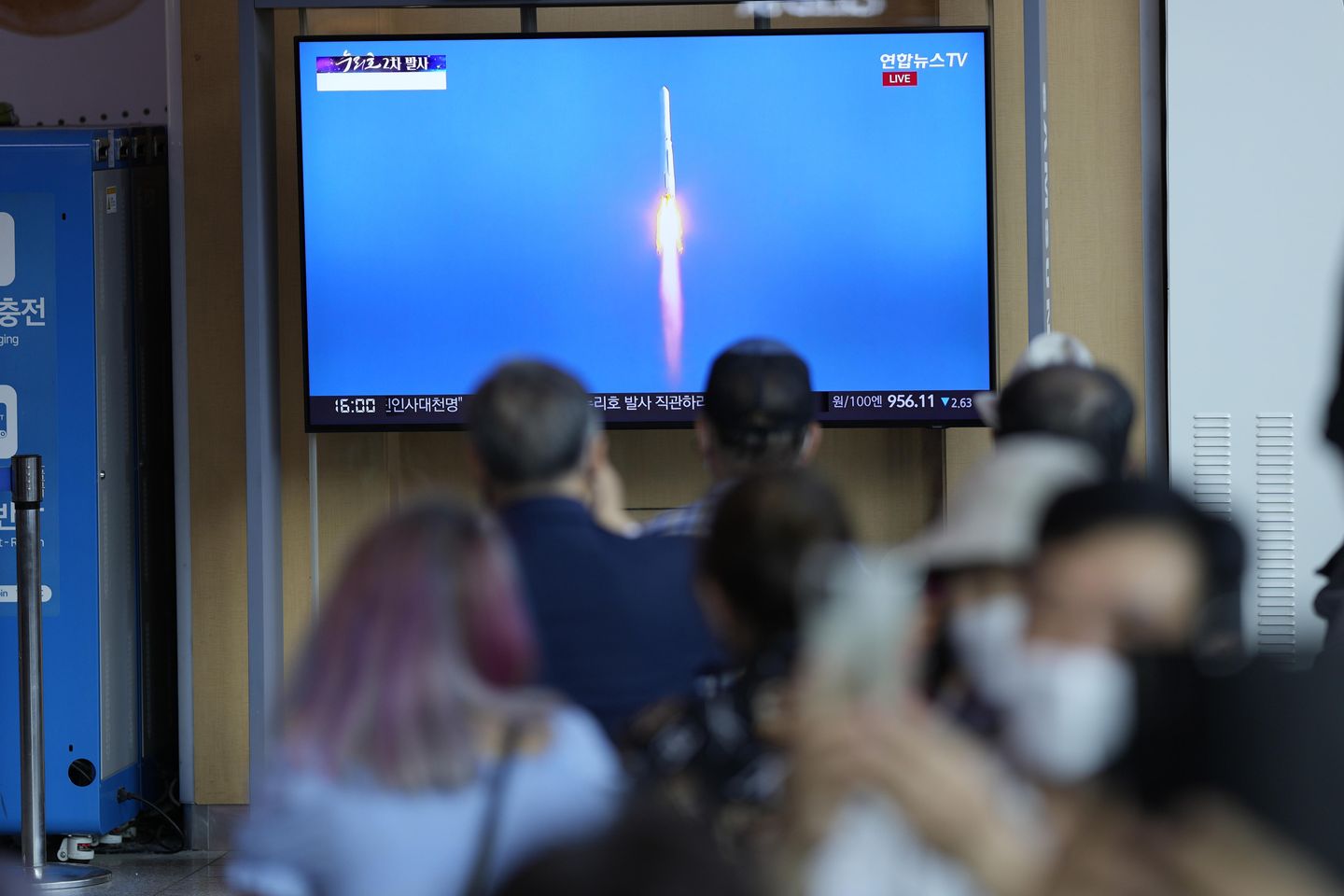
Seoul, South Korea — South Korea launched its first domestically-made space rocket on Tuesday in the country’s second attempt, months after its previous takeoff failed to place a payload into orbit.
Some experts say a successful launch will boost South Korea’s growing space ambitions, while also proving that it has key technologies for building a space-based surveillance system and larger missiles.
From the only space launch center on a small island off the southern coast of South Korea at 4 p.m., the three-stage Nuri rocket carrying what authorities are calling a working “performance verification” satellite showed the rocket’s national flag levitating in live TV footage. over bright flames and thick white smoke.
Officials will announce the results of the launch late Tuesday.
In the first attempt last October, the rocket’s pseudo-payload reached the desired altitude of 700 kilometers (435 miles), but did not enter orbit because the engine of the rocket’s third stage burned out sooner than planned.
If Tuesday’s launch is successful, South Korea will become the 10th country in the world to put a satellite into space with its own technology.
South Korea, the world’s 10th largest economy, is the main supplier of semiconductors, automobiles and smartphones to world markets. But its space development program lags behind its Asian neighbors China, India and Japan.
North Korea placed the first and second Earth observation satellites into orbit in 2012 and 2016, but there is no evidence that either is transmitting alien-based images and data home. These launches by North Korea have invited UN economic sanctions as they are seen as hatches to test the country’s banned long-range missile technology.
Since the early 1990s, South Korea has sent a number of satellites into space, but all in a rocket built from overseas launch sites or with the help of foreign technology. In 2013, South Korea successfully launched a satellite from its territory for the first time, but the first stage of the launch vehicle was built by the Russians.
After Tuesday’s takeoff, South Korea plans to launch four more Nuri rockets in the coming years. It also hopes to send a probe to the moon, build next-generation space launch vehicles, and send large-scale satellites into orbit.
South Korean officials said the Nuri rocket had no military purpose.
The transfer of launch technology into space is strictly restricted under a multilateral export control regime as it has military applications. Experts say ballistic missiles and space launch vehicles share similar hulls, engines and other components, but the missiles require a reentry vehicle and other technologies.
“If you put a satellite on top of a rocket, it becomes a space launch vehicle. But if you put a warhead on it, it becomes a weapon,” said Kwon Yong Soo, a former professor at Korea National Defense University in South Korea. If we succeed, that really makes sense because we’re also successful in testing a long-range rocket that could be used to build a long-range missile.”
Lee Choon Geun, an honorary research fellow at the South Korean Institute of Science and Technology Policy, said that using the Nuri as a direct missile was difficult because it uses liquid fuels that must be kept at an extremely low temperature and require a much longer refueling time than solid fuels. . He said North Korea’s long-range missiles also use liquid fuels, but extremely toxic ones that are kept at normal temperatures and need a faster refueling time than Nuri’s.
This year, North Korea has tested about 30 missiles with potential range that put the US mainland and regional allies such as South Korea and Japan at striking distance.
Kwon said Nuri’s successful Nuri launch will prove that South Korea is also capable of sending a spy satellite into orbit.
South Korea currently does not have its own military reconnaissance satellites and relies on US spy satellites to monitor strategic facilities in North Korea. South Korea has said it will soon launch its own surveillance satellites.
[ad_2]
Source link