

[ad_1]
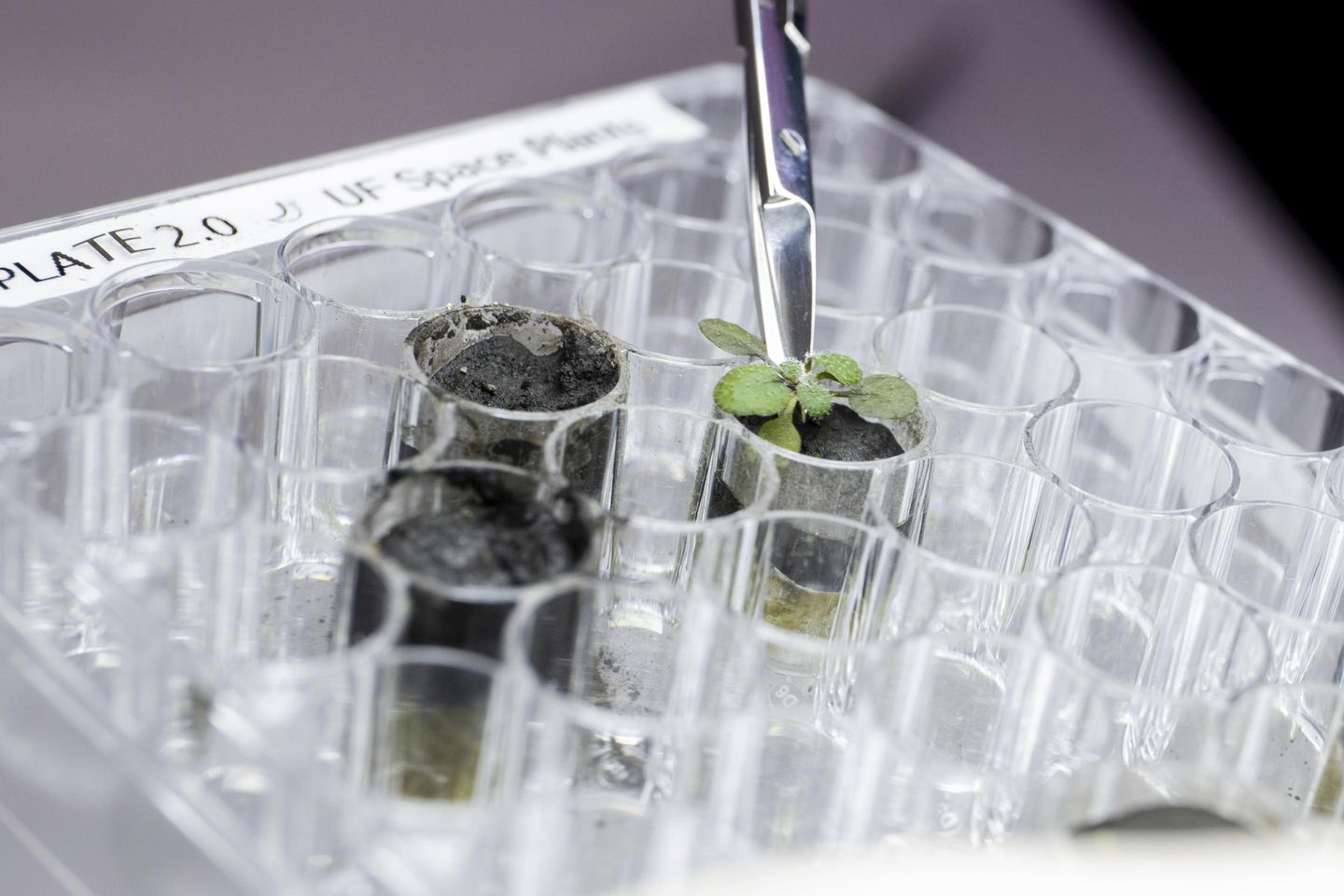
CAPE CANAVERAL, Florida (AP) — Scientists have grown plants in soil from the moon collected by NASA’s Apollo astronauts for the first time.
The researchers had no idea whether anything would sprout in the harsh lunar dirt and wanted to see if it could be used to grow food by the next generation of lunar explorers. The results stunned them.
“Holy cow. Plants actually grow on moon things. Are you kidding me?” said Robert Ferl of the University of Florida’s Institute of Food and Agricultural Sciences.
Ferl and his colleagues planted sawdust in lunar soil returned by Apollo 11’s Neil Armstrong and Buzz Aldrin and other moonwalkers. The good news: All the seeds have sprouted.
The downside is that after the first week, the coarseness and other characteristics of the lunar soil so stressed the small, flowering weeds that they grew more slowly from Earth than seedlings planted in fake lunar soil. Most of the moon plants remained stunted.
The results were published Thursday in Communications Biology.
The longer the soil was exposed to the cosmic radiation and solar wind from the moon, the worse the plants looked. According to scientists, Apollo 11 samples, which were exposed to the elements for several billion years longer due to the older surface of the Sea of Tranquillity, were the least favorable for growth.
“It’s a big step forward to knowing you can grow plants,” said space plant biologist Simon Gilroy of the University of Wisconsin-Madison, who had no role in the study. “The next real step is to go and do it on the surface of the moon.”
The lunar soil is littered with tiny shards of glass from micrometeorite impacts that reached all parts of the Apollo Moon landing craft and eroded the lunar walkers’ spacesuits.
One solution might be to use younger geological points, such as lava flows on the moon, to dig up the ground. The environment can also be fine-tuned by changing the nutrient mix or adjusting artificial lighting.
Just 842 pounds (382 kilograms) of moon rock and soil was brought back by six Apollo crews. Some of the first moon dust was sprinkled on quarantined plants with the Apollo astronauts in Houston after returning from the moon.
Most of the lunar stash remained locked, forcing researchers to experiment with simulated soil made from volcanic ash on Earth. NASA finally delivered 12 grams to University of Florida researchers early last year, and the long-awaited October took place in a lab last May.
NASA said the timing of such an experiment was finally right, with the space agency planning to send astronauts back to the moon in a few years.
The ideal situation would be for future astronauts to take advantage of the endless supply of local dirt available for indoor planting, rather than installing a hydroponic or all-water system, the scientists said.
“The growth of anything means we have a really good starting point, and the question now is how do we optimize and improve,” said Sharmila Bhattacharya, NASA’s space biology program scientist.
Florida scientists hope to recycle the lunar soil later this year, possibly by planting more cress before moving on to other vegetation.
[ad_2]
Source link