

[ad_1]
Christine McMonigal is director of hyperconverged marketing at Intel Corporation.
With more options to evaluate in a complex environment, emergencies to respond to, and complexities to understand, the need for businesses to move forward in their digital journey has never been more urgent. Changing demands, fueled in part by the covid-19 pandemic, have created the need for businesses to transition to digitalization at an unprecedented rate. IDC estimates that as early as 2022, 46% of enterprise products and services will be delivered digitally, putting pressure on companies to continue. new ways to accelerate digital transformation. Forward-thinking leaders began this journey by initiating a major shift to the cloud, which serves as the heartbeat of digital transformation and lays the foundation for future innovation.
But if digital transformation were easy, every organization would be doing it. Instead of, three common challenges occurs and can often stand in the way of an organization’s progress:
Multicloud architecture. Applications and data continue to increase and reside in various clouds. Managing them to ensure less latency, availability, and data sovereignty remains a complex undertaking.
Balancing the old with the new. In some cases, the immediate and rapid transition to the cloud has been costly. Applications or workloads moved to the cloud might be better suited to a local environment. Businesses need more flexibility to update legacy applications to cloud-native over time. Concurrently, on-premises infrastructure needs to be modernized to make it more performant, scalable and efficient, indeed more cloud-like.
Security. The modern workforce is more decentralized, increasing the attack surface for organizations. This requires a new and dynamic security strategy that is holistic.
So what is the answer for businesses to tackle these challenges? A pragmatic foundation for a modern digital infrastructure hybrid cloud. It optimizes application deployments across locations, providing the highest level of agility in response to changing business needs. The on-premises side of hybrid cloud is best deployed through hyperconverged infrastructure or HCI, which blends old and new with modernization that facilitates the transition.
This approach combines virtualized computing and storage resources with intelligent software on standard server hardware, creating flexible building blocks that aim to replace or optimize legacy infrastructure while providing greater agility. With this approach, many parts are brought together to deliver a version of cloud infrastructure with dynamic scalability and simplified operations.
Achieve agility through hybrid cloud
Delivering high performance is a requirement for IT environments that rely on mission-critical databases and latency-sensitive applications. This is especially important in dynamic environments where data growth is steady and constant access is a requirement, often coupled with the demand for new analytics and insights. The ability to easily meet these performance and scalability requirements is essential for any business deploying hyperconverged infrastructures.
Microsoft and Intel are working together to take the best of software and combine it with the best hardware technologies to provide organizations with a flexible infrastructure that can agile today’s demands and adjust the pace of digital transformation.
Flexibility combined with seamless management
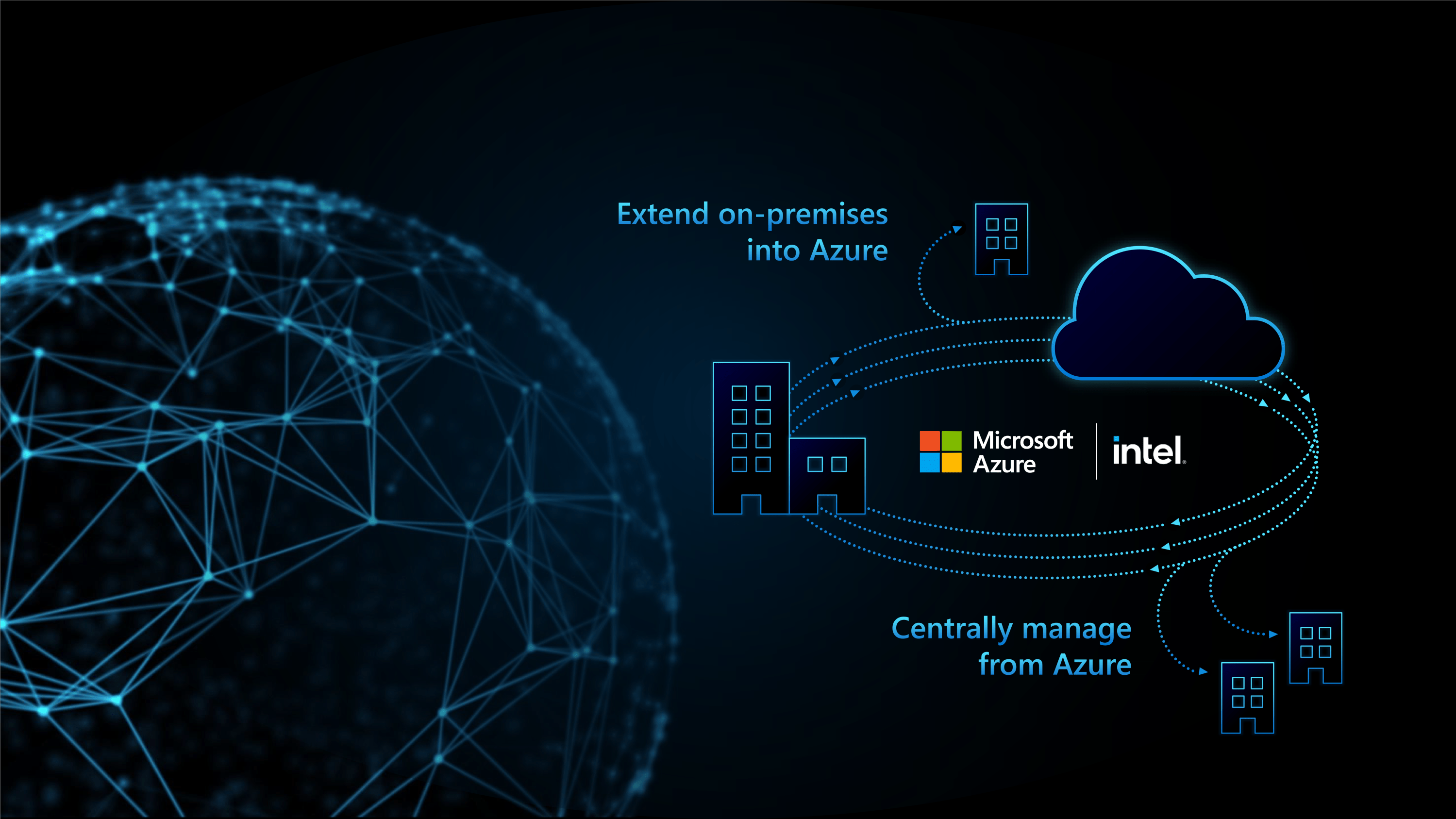
Solving the problem of navigating and orchestrating multiple cloud architectures requires a control plane that offers simplified management of both on-premises and public cloud-based resources. The hybrid offering through Azure Stack HCI (available as a service) provides a comprehensive answer to this challenge. With integrated services like Azure Stack HCI and Azure Arc, you can easily manage and manage on-premises resources along with Azure public cloud resources from a single control plane.
Any viable hybrid cloud offering must reduce complexity through simplified management while increasing agility, scalability, and performance. With optimized on-premises hardware and legacy functionality and improved workload virtualization, you can sustain existing operations and scale at the speed that best suits your needs. Azure Stack HCI effectively balances the old with a new, supportive evolution of on-premises operations to be part of your cloud operating model, from the core data center to the edge and cloud.
Seamless management also includes maintaining a holistic and comprehensive security posture so that relevant risks can be managed without compromising effectiveness. As computing complexity increases across the data centre, edge, and cloud, these risks can increase if left unaddressed. Security must go hand in hand with digital transformation. Intel and Microsoft lead with a reliable foundation from software to the silicon layer. We’ll be announcing a number of new technologies to keep data safe and in use soon, and we’ll go deeper into data protection and compliance in the next article in this series.
A hardware foundation to deal with the digitization of everything
The importance of semiconductors continues to grow as we continue to see increasing reliance on analytics tools and artificial intelligence for data insights to manage operations and customer touchpoints. This digital surge is increasing demands for more computing power; an organization’s infrastructure has suddenly changed from tactical to epicenter of new strategic business opportunities.
Building a flexible hardware infrastructure based on business demands is one of the keys to unlocking the potential of an agile hybrid cloud that can quickly and easily move workloads across different environments. Intel’s mission is to provide the best technology foundation with built-in capabilities across performance, AI, and security that unlock new business opportunities today and in the future. At the heart of this foundation are 3rd Gen Intel® Xeon® Scalable processors.
Intel and Microsoft are working together to reduce the time required for evaluation, selection, and procurement and streamline the time to deploy new infrastructure using fully integrated, tested, and ready-to-deploy technologies. As proof of this, Microsoft and Intel recently tested Azure Stack HCI on the latest Intel technologies, demonstrating 2.62 million SQL Server new orders per minute, one of the most popular workloads among enterprises. These optimized configurations are available as Intel® Select Solutions for Azure Stack HCI from multiple server OEMs and scale partners.
Meeting the needs of dynamic IT environments
There has never been such a dynamic period for businesses; now is the time to adopt the hybrid cloud. Azure Stack HCI charts a new easy path for hybrid with Intel as the technology foundation to modernize infrastructure and turn it into strategic advantage.
If you’re ready to optimize manageability, performance, and costs while integrating on-premises data center and edge infrastructures into your hybrid and multicloud environment, learn more about Azure Stack HCI today.
Check out the latest Intel-based Azure Stack HCI systems and continuous innovation Azure.com/HCI. While you’re there, download the software Microsoft offers for a free 60-day trial.
This content is produced by Microsoft Azure and Intel. It was not written by the editorial staff of MIT Technology Review.
[ad_2]
Source link